
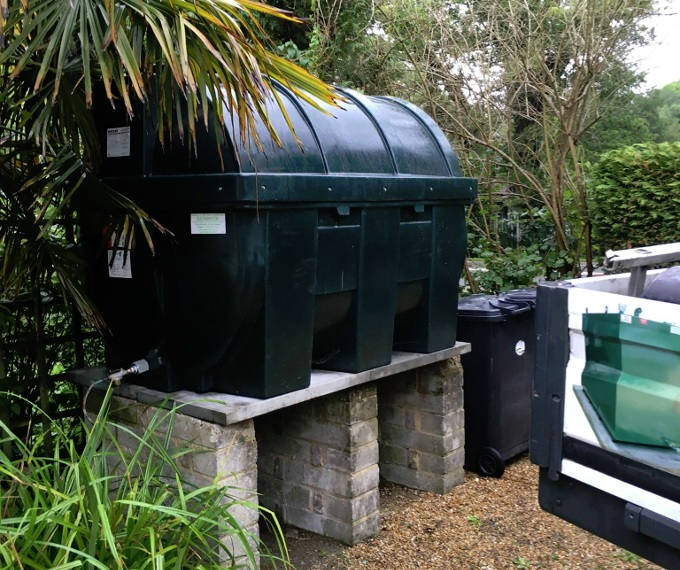
A replacement oil tank may appear to be a straightforward swap, until the installer finds that the old base is unsuitable, access is restricted or the tank needs a safer position. That is why a well-planned installation starts before delivery day. Here is what homeowners can expect, from the first survey to the final handover.
The oil tank installation process usually includes a site survey, choosing a suitable tank, agreeing a quotation, preparing the base and access, delivery, safe handling of any remaining oil, pipework connections and final checks. An old tank may also need to be removed. The order of work depends on whether the replacement is going in the same position or somewhere new.
1. Start with an oil tank site survey
A site survey is where the installer works out what is practical and safe for your property. SG Tanks offers free, no-obligation site surveys and advice. It is best to arrange this before buying a tank, particularly if you are replacing an older installation.
The survey should cover:
- Tank location, including distances from buildings, openings, boundaries and potential fire hazards.
- Access for delivering the new tank and taking away the existing one.
- Whether the base can support the proposed tank and its contents.
- The fuel-line route, valves and connections to the heating system.
- Environmental risks, such as nearby drains, streams or other water sources.
A wooden fence or garden structure added since the last tank was installed may affect where a replacement can safely stand. Resolving this at the survey stage can prevent extra work and expense on installation day.
For more detail, see SG Tanks’ advice on positioning a bunded oil tank.
2. Choose a tank that suits the property
The survey findings help determine the capacity, shape and material of the new tank. Plastic tanks suit many domestic properties; steel can be useful where dimensions are more restrictive. SG Tanks also manufactures made-to-measure steel tanks, so an awkward space does not always mean settling for an unsuitable standard shape.
The installer must also assess whether secondary containment is required. A bunded tank has an outer containment layer to help retain oil if the inner tank leaks. In England, bunding is required in specified higher-risk situations, including where spills could enter an open drain or where a tank is within 10 metres of inland fresh water. Domestic tanks holding more than 2,500 litres also require bunding under government guidance. The full requirements depend on the site assessment.
If you are comparing designs, read SG Tanks’ guide to single-skin and bunded oil tanks.
3. Understand what the installation quote covers
The quotation should explain the complete job, not just the cost of the tank. Two similar-looking properties can require very different amounts of labour and preparation.
Check whether the price covers:
- The agreed tank model and capacity, delivery and positioning.
- Any new base, alterations to the location or fire protection measures.
- Fuel lines, valves, filters and other necessary fittings.
- Assessment and transfer of remaining usable oil, if appropriate.
- Emptying, removal and disposal of the old tank, where required.
- Testing, any applicable compliance arrangements, VAT and exclusions.
Ask what will happen if the survey identifies additional work and when your heating supply may be interrupted. Having this agreed in advance gives you a more meaningful comparison between quotes.
SG Tanks provides an overview of its oil tank installation services and the options available for different properties.
4. Prepare the base and access route
The tank must stand on a suitable base. OFTEC’s domestic storage guidance describes a level, non-combustible base without holes or gaps, capable of supporting the full tank, and extending at least 300mm beyond every side. The installer should assess the actual specification and current requirements for your tank and site rather than assuming an old base is acceptable.
If a new concrete base is needed, construction and curing time may be required before the tank can be fitted. Clear movable items from the access route, confirm vehicle access and tell the installer roughly how much oil is left in the old tank. Keep children and pets away from the work area. Do not attempt to drain or disconnect a tank yourself.
5. Plan removal, delivery and positioning in the right order
There is no single sequence for every replacement. If the new tank needs to occupy the old tank’s position, the existing tank may first have to be emptied, made safe and removed. If the replacement is going elsewhere, the new base and tank may be prepared before the old installation is disconnected. The survey and quotation should make the planned order clear.
SG Tanks’ published customer feedback describes a replacement steel-tank job in which the oil line had to be routed beneath an existing driveway. It is a useful reminder that access and pipework can matter as much as the tank itself. The specific work should be agreed for your own property, not inferred from someone else’s installation.
6. Connect the pipework and manage remaining oil
Once the new tank is positioned, the installer can fit or adapt the appropriate fuel lines, valves and fittings. During a replacement, any oil left in the old tank needs to be assessed before it is moved. Usable fuel may be transferred using suitable equipment, but water, sludge or other contamination should not simply be pumped into the new tank.
Depending on the layout, oil may need to be held safely while the old tank is removed and the new one installed. Ask how fuel transfer, any unusable residue and disposal will be managed, and whether those services are included in the quotation.
For unwanted or damaged tanks, SG Tanks also offers oil tank removal services.
7. Final checks and handover
Before the installation is used, the installer should inspect the tank and connections, check for leaks and carry out the testing appropriate to the work completed. You should be shown how to check the oil level, recognise signs of a problem and arrange future inspections. Ask what documentation is applicable and who is responsible for providing it.
New or replacement domestic oil storage installations in England must comply with Building Regulations. A suitably registered competent person may self-certify qualifying work; otherwise, a Building Control application and inspection may be required. The correct route should be agreed before work starts. The precise handover documents will depend on the installation and compliance route.
How long does oil tank installation take?
There is no reliable single timescale for every property. The fitting visit is only one part of the project: the survey, tank availability, base construction, access arrangements and any change to pipework can all affect the completion date.
When comparing quotations, ask two separate questions: when can the installation start, and how long is the heating likely to be unavailable? Your installer should be able to explain the likely sequence after surveying the site.
Arrange your oil tank installation survey
SG Tanks has more than 20 years of experience supplying, installing and removing oil tanks across Sussex, Surrey and Hampshire. The team can help you understand the options for your property, whether you need a straightforward replacement or a different tank position.
For a free, no-obligation survey, request a quotation from SG Tanks or call Sean and the team on 01903 856403.

